Showing posts with label Iran. Show all posts

Thursday, August 16, 2007

Congress hearts Iran sanctions too

Galrahn, the Armchair Admiral, recommended that I also do an analysis of the Iran sanctions bills currently moving through the House and Senate.

One of these three bills is the "Iran Sanctions Enabling Act of 2007" that was originally sponsored by Representative Barney Frank (D-MA) and introduced in the House in May.

HR.2347 "Iran Sanctions Enabling Act of 2007"

The bill orders the Department of Treasury to maintain a list of foreign or U.S. persons who have invested more than $20 million in the Iranian oil industry. It then gives investors who divest themselves from a person on the Treasury list a safe harbor from civil, criminal and administrative actions and suits against the divestiture.

It also makes it the policy of the United States to support decisions by state and local governments and educational institutions to divest themselves from persons who are on the Treasury list.

The bill was passed by a hefty margin (408-6) in the House in early July and was introduced in the Senate in early August. I know socially responsible investing is really popular with folks on the left, but I bet the tangible impact of this Representative Frank's bill will be marginal.

The other two bills share the title "Iran Counterproliferation Act of 2007" and share most of the same content. The House version was introduced in March 2007 by Representative Tom Lantos (D-CA).

HR.1400 "Iran Counter-Proliferation Act of 2007"

The Lantos bill closes off the exemptions for the importation of Iranian rugs, foodstuffs and informational materials and the exportation of civil aviation safe equipment. Not surprisingly, exemptions for medicine and food exports are left alone, no doubt the handiwork of the pharmaceutical and farm lobbies.

It also mandates the President impose six types of sanctions on persons found to be violating the Iran Sanctions Act of 1996. Currently, the President is only require to impose two sanctions from a list that includes exclusion from the U.S. financial system, being listed as a denied party under all of the major export control regulations and disbarment from doing business with the U.S. government. It also removes the President's ability to waive these sanctions under any circumstances.

The bill also makes the foreign subsidiaries of any U.S. company subject to the Iran Sanctions Act by making the parent company liable for the subsidiary's sanctions busting. The definition of a foreign subsidiary is also defined down from super majority ownership to simple majority ownership.

Ironically, Lantos's bill would require that the executive list the Iranian Revolutionary Guard Corp as a 'specially designated global terrorist,' a 'foreign terrorist organization' and a 'weapons of mass destruction proliferator.'

S.970 "Iran Counter-Proliferation Act of 2007"

The Senate version of this bill was introduced shortly after the Lantos bill in March 2007 by Senator Gordon Smith (D-OR).

The only major difference between the House and Senate bills is that the Senate takes the additional step of negotiation and implementation of a U.S.-Russian 123 agreement until the President can certify that Russia has stopped assisting the Iranian nuclear program.

Given the broad scope of unilater U.S. sanctions already imposed on Iran and persons who deal with Iran, I imagine the impact of any of these measures will be marginal as best. At worst, they will have no impact on Iran while driving a larger wedge between Russia, Europe and the U.S.

Wednesday, August 15, 2007

What's better than sanctions? More sanctions!

I had to produce an primer for my boss and coworkers today about the Bush administration's decision to declare the Iranian Revolutionary Guard Corp a 'specially designated global terrorist' and I figured I would share it with my readers:

What happened?

The United States Government designated the Iranian Revolutionary Guard Corps, a subset of the Iranian military, to be a 'specially designated global terrorist group' pursuant to the rules of Executive Order 13224 signed by President George W. Bush on September 23, 2001.

What is Executive Order 13224 and what is an SDGT?

E.O. 13224 allows the U.S. Government to block the property of any person (including corporate persons) in the U.S. that is listed in the order's annex. It also allows the government to block transactions between U.S. persons and anyone listed in the annex.

The Secretary of the Treasury, Secretary of State or Attorney General also have the power to declare a U.S. person or person within the U.S. as being subject to the limitations imposed by the order. The grounds for such a declaration are if that person has 'committed or poses a significant risk of committing acts of terrorism that threaten the security of U.S. nationals or the national security, foreign policy, or economy of the U.S.' or if that person has 'assisted, sponsored, or provided financial, material or technological support or other services' to support acts of terrorism or to persons listed in the annex.

SDGT is just a fancy way of referring to the individuals and groups on in the E.O.'s annex. The simplified list of SDGTs is 11 pages long, while the detailed list is a little over 100 pages long.

What has changed?

In practice, the 'State Sponsor of Terrorism' designator hasn't translated into the same set of restrictions for each country on the state-sponsors list. For Iran, being on the 'bad boys' list means that no U.S. person or person within the U.S. can trade with or conduct transactions in Iran or with the Iranian Government. There is a narrow exception to this rule for importing Iranian trinkets, information, foodstuffs and, most importantly, Persian rugs, through foreign intermediaries.

Being designated an SDGT closes the Iranian Transaction Regulations' import exemptions on trinkets, food and carpets. It also allows the U.S. government to go beyond merely blocking transactions to actually freezing IRCG assets in the U.S. or held by U.S. persons.

It is not clear whether this change will actually have a tangible impact on the IRCG. The U.S. government seized most Iranian government assets shortly after the 1979 revolution. It has imposed an unilateral embargo on Iran continuously since E.O. 12613 was put in place by the Reagan administration.

There have been so few opportunities to legally acquire any Iranian property that I imagine the number of U.S. persons or persons in the U.S. holding IRCG assets is microscopic.

Is this going to be BDA Redux?:

Maybe. If the SecTreas, SecState and AG decide to use their authority to determine whether someone has assisted or provided support for the IRCG liberally, they could prohibit U.S. persons or persons in the U.S. from doing business with foreign firms that do business with the IRCG and its avatars.

That would be same tactic used by the Treasury Department to pressure Banco Delta Asia in Macau into freezing $25 million in North Korean assets. Iran's economy is less isolated from the world market than North Korea, so it is unclear whether the BDA strategy will be effective in this instance.

Either way, it definitely a bad day to be in the Persian carpet business. Maybe the industry should rebrand their products freedom rugs...

Monday, August 6, 2007

So what's up with these Near East arms deals?

One news item from recent headlines is Bush administration's plans to build up a tighter anti-Iran block in the Near East through arms deals. Specifically, they plan to sell at least $20 billion worth of arms to the members of the Gulf Cooperation Council (Saudi Arabia, Bahrain, Kuwait, Oman, Qatar and the United Arab Emirates), as well as increase the amount of military aid given to Israel and Egypt.

Before I critique the Bush administration's approach, I would like to correct a common misunderstanding about U.S. arms sales to the Near East. First of all, the U.S. sells hundreds of millions of dollars worth of arms to GCC states on an annual basis. Between 2000 and 2006 alone, Saudi Arabia purchased $5.8 billion worth of defense articles and services through the Foreign Military Sales system. We also signed off on direct commercial sales of $1.8 billion worth of U.S. defense articles and services to the Saudis as well. (Both FMS and DCS numbers compiled from annual reports, send me an e-mail if you want them in a spreadsheet.)

The Bush administration is proposing that we relax some of the limitations we have placed on the types of weapons the U.S. can sell to Saudi Arabia. To be fair, some of these restrictions were based on tensions between Israel and its Arab neighbors, so relaxing them now makes sense in the face of recent Arab-Israeli detente. If we're going to sell arms to the GCC states anyways, we might as well sell them as much as we can for practical economic reasons, if not strategic ones. As one Navy-focused blogger points out, if the Saudis can't buy more advanced weaponry from the United States, there are plenty of other relatively advanced arms exporting states willing to fill the gap.

The real flaw of this decision is that it will probably do nothing to achieve its intended goal of adjusting the military balance between the GCC states and Iran. As Bill Arkin aptly points out, the Saudis and their GCC neighbors aren't planning on buying the advanced weapons we are offering in large enough quantities to be useful. His point about the drivers and limitations behind Saudi procurement planning is particularly important. The Saudis will only buy enough JDAMs, F-16s and M1A2s to keep their prince-generals happy. They cannot buy enough to become a force of reckoning the Near East because they afraid of making their military too powerful.

If you take a look at the publicly available Function 150 sales toplines published by the State Department, there appears to be some evidence of this. The Saudis averaged about $700-800 million in arms purchases between 2000 and 2006. If you look at the 655 Reports that the Federation of American Scientists obtained for these years, the largest portion of annual Saudi purchases are for defense services (i.e. maintenance, logistics, administration, training, etc.).

Even though this $20 billion deal will effectively double Saudi spending on arms imports, I am sceptical about how much of this spending will actually go to platforms. History doesn't paint an optimistic picture. If the arms sales only serve as a window dressing on the U.S. side (subject to interpretation) of the military balance across the Persian Gulf and if al Qaeda uses U.S. arms sales to House of Saud as a justification for its mission, then why sell them arms to begin with? The only reason I can think of is that we really have viable alternative.

Our hands are tied by decades of 'lowest common denominator' policy-making capped off by the invasion of Iraq and the complete collapse of the Bush administration's freedom agenda.

Oh well, just add the Near East to the list of Baby-Boomer legacies that my generation will spend their entire careers trying to fix.

Thursday, May 24, 2007

MC Ahmadinejad's New Album

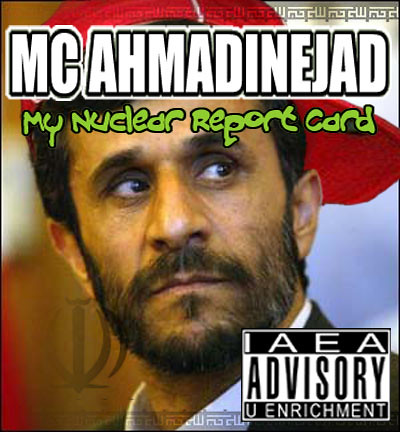
In celebration of the IAEA's new report on the implementation of NPT safeguards in Iran, MC Ahmadinejad has released a new album entitled "My Nuclear Report Card."

Update: For those not familiar with the burgeoning hyphy hip-hop scene coming out of the San Fransisco Bay area, this cover is loosely patterned off of album cover of E-40's My Ghetto Report Card. Its a terrible album by the way -- the only redeemable song is last summer's hit "U and Dat."

Thursday, March 1, 2007

Ahistory is the new history

I definitely suggest reading Seymour Hersh's new article in the New Yorker Magazine. As per usual, Hersh manages to drop little tidbits about the secret goings-on in the Pentagon. White House and Foggy Bottom (now that State has been brought back in from the cold). The U.S. is supporting covert action against Iran and Syria, a Pentagon task force has been pulled together to plan out strikes against Iran's nuclear program, etc.

The most striking thing about Hersh's article is the incredulous manner in which he describes the Bush administration's decision to back friendly Sunni governments in the Near East:

The new American policy, in its broad outlines, has been discussed publicly. In testimony before the Senate Foreign Relations Committee in January, Secretary of State Condoleezza Rice said that there is “a new strategic alignment in the Middle East,” separating “reformers” and “extremists”; she pointed to the Sunni states as centers of moderation, and said that Iran, Syria, and Hezbollah were “on the other side of that divide.” (Syria’s Sunni majority is dominated by the Alawi sect.) Iran and Syria, she said, “have made their choice and their choice is to destabilize.”

Some of the core tactics of the redirection are not public, however. The clandestine operations have been kept secret, in some cases, by leaving the execution or the funding to the Saudis, or by finding other ways to work around the normal congressional appropriations process, current and former officials close to the Administration said.

[snip]

The policy shift has brought Saudi Arabia and Israel into a new strategic embrace, largely because both countries see Iran as an existential threat. They have been involved in direct talks, and the Saudis, who believe that greater stability in Israel and Palestine will give Iran less leverage in the region, have become more involved in Arab-Israeli negotiations.

The new strategy “is a major shift in American policy—it’s a sea change,” a U.S. government consultant with close ties to Israel said. The Sunni states “were petrified of a Shiite resurgence, and there was growing resentment with our gambling on the moderate Shiites in Iraq,” he said. “We cannot reverse the Shiite gain in Iraq, but we can contain it.”

I know Mr. Hersh is a journalist by training, but I figured he might know something about history since he lived through all the juicy parts of the Cold War. The question I would pose to him is this: Since when has U.S. policy in the Near East not involved propping up Sunni governments that share our strategic aims at the expense other U.S. foreign policies and aims?

Since 1979, the U.S. has provided for the security of many of our Sunni allies through a combination of security guarantees, Foreign Military Financing (FMF) and loosened arms export rules under the policy-driven Foreign Military Sales (FMS) program.

Even if you take Israel ($2.26 billion) and Egypt's ($1.29) clearly out sized portions out of Fiscal Year (FY) 2006 FMF expenditures ($4.64 billion), four Sunni-led countries of the Near East (Lebanon, Jordon, Oman, and Bahrain), Tunisia and Pakistan comprise over 50% of the remaining $1.09 billion.

Things are pretty much the same on the FMS-side of U.S. policy in the Near East. Each country receiving FMF in the form of grants or loan subsidies spends their money on U.S. arms, in addition to their own (sometimes) generous expenditures. Then the oil-producing Sunni states (Kuwait, Saudi Arabia and the United Arab Emirates) each drop hundreds of millions annually on U.S. hardware (more than $700 million each in FY2006). When things are all said and done, the Near East (which includes Pakistan) buys more arms from the U.S. government than any other region in the world, including Europe (about $7.7 billion in 2006). (All of my figures from the FY2008 Foreign Operations budget justification, which is surprisingly navigable for being 700 pages)

Hersh's incredulity doesn't stop there, he also picks up on the negative consequences of U.S. policy in the Near East:

“It seems there has been a debate inside the government over what’s the biggest danger—Iran or Sunni radicals,” Vali Nasr, a senior fellow at the Council on Foreign Relations, who has written widely on Shiites, Iran, and Iraq, told me. “The Saudis and some in the Administration have been arguing that the biggest threat is Iran and the Sunni radicals are the lesser enemies. This is a victory for the Saudi line.”

Martin Indyk, a senior State Department official in the Clinton Administration who also served as Ambassador to Israel, said that “the Middle East is heading into a serious Sunni-Shiite Cold War.” Indyk, who is the director of the Saban Center for Middle East Policy at the Brookings Institution, added that, in his opinion, it was not clear whether the White House was fully aware of the strategic implications of its new policy. “The White House is not just doubling the bet in Iraq,” he said. “It’s doubling the bet across the region. This could get very complicated. Everything is upside down.”

[Snip]

Flynt Leverett, a former Bush Administration National Security Council official, told me that “there is nothing coincidental or ironic” about the new strategy with regard to Iraq. “The Administration is trying to make a case that Iran is more dangerous and more provocative than the Sunni insurgents to American interests in Iraq, when—if you look at the actual casualty numbers—the punishment inflicted on America by the Sunnis is greater by an order of magnitude,” Leverett said. “This is all part of the campaign of provocative steps to increase the pressure on Iran. The idea is that at some point the Iranians will respond and then the Administration will have an open door to strike at them.”

Making Iran out to be the bad guy while downplaying the impact of Sunni extremism? Complicated relationship with Iraq? Toto's hit song "Africa" is at the top of the charts? All that is missing is a handshake like this:

U.S. strategic myopia has once again begun to shift away for complex transnational security issues that require well thought-out, nuanced solutions. It is time to fixate on the handful of international political conflicts that offer opportunities to articulate policies that easy for our Cold War-era government to implement, such as containment, deterrence, coercive diplomacy, sanctions and the Bush administration's favorite, punitive military action.

Look, I'm not saying that Bush administration policy is wrong or that we really have feasible policy given our circumstances. All I would like is for someone besides myself to acknowledge that except for a brief period in 2003, U.S. policy in the Near East hasn't changed much since the late 1980s.

Mr. Hersh, if you really want to know what is at the core of my concerns for America's future in the international community, it is not the Pentagon's plans for action against Iran. It is utter lack of originality and willingness to implement complex policies that require significant political commitment (arms control, regional security integration and diplomatic engagement) that makes me reluctant to bring children into this world.

Monday, February 19, 2007

No more broken links

That's it, I've had it with these motherf**king broken image links on this motherf**king blog. 23, it is time to let you go. I was inital hesitant to sign up to Flickr because it might not have protected my nom de plume. It turns out the site does, so if you're ever surfing pictures on flickr, please check out my profile.

Oh and by popular request, I am bumping my MC Ahmadinejad picture up. Enjoy.

Monday, February 12, 2007

The Iran connection under the microscope

Bush administration finally released its dossier on Iranian involvement in Iraq over last weekend. First of all, I'm not exactly won over by the incredibly tight circumstances under which this information was briefed. According to the Post's report assembled by Joshua Partlow (with help from Dafna Linzer and Naseer Mehdawi):

The officials said they would speak only on the condition of anonymity, so the explosives expert and the analyst, who would normally not speak to the news media, could provide information directly. The analyst's exact title and full name were not revealed to reporters. The officials released a PowerPoint presentation including photographs of the weaponry, but did not allow media representatives to record, photograph or videotape the briefing or the materials on display.

Nameless experts and a "no-fingerprints" brief? As a professional skeptic and a libertarian, I am already a little dubious about what will follow. Despite my uneasy feelings, Partlow definitely picked up some interest bits of information:

The U.S. officials said weapons were smuggled into the country by the Quds Force, an elite unit of the Iranian Revolutionary Guard that U.S. officials believe is under the control of Iran's supreme religious leader, Ayatollah Ali Khamenei. The officials in Baghdad said that Iranians recently detained in Iraq by U.S. forces belong to the Quds Force.

I'll buy this much. Veteran Near East-watchers know that the Quds Force was a key element of Revolutionary Guard's efforts to infiltrate Iraq during the 1980-1988 war between the two states. It wouldn't surprise me if they've managed to revive some previously dormant contacts or back-channels.

With so much official U.S. buildup about the purported evidence of Iranian influence in Iraq, the briefing was also notable for what was not said or shown. The officials offered no evidence to substantiate allegations that the "highest levels" of the Iranian government had sanctioned support for attacks against U.S. troops. Also, the military briefers were not joined by U.S. diplomats or representatives of the CIA or the office of the Director of National Intelligence.

Nothing new here.

U.S. military officials in Iraq had previously described the use of "explosively shaped charges" to target vehicles, but Sunday's briefing was the first time they displayed pieces of what they called an "explosively formed penetrator" or EFP. The one such device shown at the briefing was a cylinder of PVC pipe about eight inches long and about six inches in diameter. The officials said the devices are deadly because the explosion sends a slug of malleable metal, often copper, at velocities high enough to penetrate the armor of tanks and Humvees. Their components require precision machining that Iraq has shown no evidence of being able to perform, the officials said. The first known attack using such weapons in Iraq occurred in May 2004, and the rate of attacks using them has nearly doubled in 2006, the officials said. They have also been used in southern Lebanon, the explosives expert said. The Lebanese Shiite organization Hezbollah receives military support from Iran.

Now we're getting to the good stuff. For the sake of argument, I'm willing to accept the assertion that the shaped charges used in many of the EFPs going off in Iraq are from abroad. The HMX, RDX, and TNT blends typically used in EFPs aren't exactly easy to produce in large quantities outside of a factory setting though. I doubt few of Iraq's Saddam-era munitions factories are still operational after the initial U.S. invasion and four years of looting and neglect.

The weapons displayed for reporters on two tables on Sunday -- rocket-propelled grenades, football-shaped mortar shells, the shaped explosive charge and about 40 tail fins of exploded mortar shells -- showed specific signs of Iranian manufacture, the officials said. The mortar tail fins, for example, were made from a single fused piece of metal, while other countries make mortar shells that have removable parts, the explosives expert said. Two rocket-propelled grenades, with the markings "P.G. 7-AT-1," were said to be made exclusively in Iran.

I'm not a mortars person, so I can't comment on their "signs of Iranian manufacture" claim. Based on the markings provided, I bet the rocket-propelled grenade round went to an RPG-7 - the ubiquitous "Libyan terrorist popping out of the roof of a VW Bus from Back to the Future" Soviet-designed RPG. The Iranians can probably manufacture this icon of Third World weaponry, but they are far from the only potential source in the Near East.

In conclusion, this dossier may have some tantilizing evidence of Iranian involvement in Iraq, but given the Bush administration's low credibility, it will mean little until the public has a chance to assess it.

Update: Some intrepid McClatchy/Knight-Ridder reporter managed to get his/her hands on the Powerpoint presentation. There is definitely Farsi writing on the package of TNT on the 10th slide. The last slide is supposedly a Misagh-1 (a knock-off of the Chinese Vanguard), but there is not way to tell from the photo. There are lots of circles around the manufacture dates - most of which are from 2006. Does that essentially help the American case that Iran has been involved in Iraqi violence going back 2-3 years?

Thursday, February 1, 2007

PMF exam

The deed is done and it only took 4 hours. I feel like Photoshoping something when I get home. Check back tomorrow morning.

I think the theme will be: "MC Ahmadinejad seyz the rims keep spinnin' even after the centrifuges stop."


Update: I just realized that I don't have any webspace to host a picture. Nevermind then...

Second Update: J pointed out that I could use Flickr. Smart guy. Too bad its Super Bowl weekend or I'd have time to upload a few of my concepts.

As promised: (I fiddled with the size a little)

Note: It appears 23 is giving me too many broken links. I have opened up a Flickr account (after setting aside initial suspicions that Yahoo! wouldn't hide my real name). I've also taken to uploading my picture directly to the blog. We'll see what works.

Sunday, January 28, 2007

Reverse Oil Weapon?

There was a great article in the December 26, 2006 edition of the Proceedings of the National Academy of Sciences by Roger Stern that has largely flown under the political radar in Washington. Using open-source, non-Farsi materials on the Iranian oil industry, Stern explores Iran's argument for developing nuclear power in the face of its vast oil resources. His thesis is that the declining productivity of Iran's state-controlled oil industry and the exploding costs of domestic energy subsidies will cause its oil exports to completely evaporate somewhere between 2012 and 2022. Iran, therefore, does has a significant interest in pursuing nuclear energy to stave off this inevitable economic crisis in Tehran.

The report is short, but pretty wonky. Stern's math is pretty solid and his case is fairly convincing given how badly the Ahmadinejad administration has bungled oil politics in Tehran over the past year and a half. The article's only weakness is that it assumes that the Iranian government won't make the difficult choice of cutting domestic fuel subsidies when push comes to shove on the budget. Analysts said the same thing about Indonesian President Susilo Bambang Yudhoyono's administration back in 2005, but he managed to cut his country's substantial fuel subsidies twice without too much trouble.

That being said, the most intriguing part of the article, however, is the author's musings an American 'oil attack' on Iran:

Iran's petroleum crisis is a strategic opportunity. Unless price increases, export erosion seems likely to reduce the regime's monopoly rent stream. Such a dynamic seems propitious for some policy to compound the regime's self-inflicted problems. A nonviolent, economic attack on monopoly price is such a policy.

A price attack implies measures that would erode market power and hence reduce price. Market power exerted through OPEC investment restraint is responsible for most of the difference between the $4- to $10-per-barrel competitive price and market price, which has been much higher for most of the past 33 years. This difference underwrites the Islamic Republic, the need for U.S. force projection in the Gulf, and many other security problems (4). An analogous target in a military campaign would be an adversary's industrial capacity. Market power should be understood in this way, as inseparable from the threats it underwrites but also more vulnerable.

A price attack implies forced adoption of fuel-efficient technology by importing states. The resulting fuel efficiency (f-e) improvement would have to reduce demand by enough to force cartel producers to defend price, which they would do by reducing supply. Equitable sharing of supply cuts is an inherent problem for any cartel that lacks an enforcement mechanism for market sharing agreements.

[snip]

The most efficient policies to force f-e would be fuel taxation, cap and trade mechanisms (for horsepower, emissions, or miles traveled), or fleet f-e standards. Given what appears to be a decreasing price elasticity of gasoline demand in the U.S., some combination of standards and taxation might be most successful. The burden of new taxation could be partially offset by reductions to payroll or other taxes. Although the optimal price attack policy cannot be known, present U.S. energy policy is nonoptimal in that it ignores price. Energy policy has been adopted in response to the imaginary problem of oil dependence (4), which has reduced it to a quest for tax preferences by domestic producers.

Whatever policy might be adopted to mount a price attack, light-duty vehicles (LDVs) would be the source of most demand reductions because they are the least efficient among all oil-demand technologies. Unfortunately, Americans are not savers, new car consumers least of all. Indeed, car consumers may discount f-e savings almost to zero. Yet, although f-e may be unattractive to consumers, a policy to force adoption would be akin to a mandatory savings plan like social security but with higher returns.

I think this is the first time that someone has ever explicitly tied energy conservation together with foreign policy and national security. I don't know if the federal government could change conversation policy rapidly enough to impact Tehran, while at the same time minimizing its impact on U.S. economy. One thing's for sure though, this conservation-foreign policy link is definitely a lot more rational than the old "energy independence" meme.

This kind of puts those over-the-top "driving SUVs supports terrorism" commercials made by Americans for Fuel Efficient Cars in a whole new context though.

Monday, January 22, 2007

Iran tests super missile that will defeat the Great Satan and steal your girlfriend

There was a piece on Military.com (still up at Salon.com) yesterday that parroted some hilarious Iranian claims about the capability of their missiles :

Stressing Iran's preparedness, state television said the Revolutionary Guards planned to begin three days of testing the short-range Zalzal and Fajr-5 missiles Sunday. It could not be confirmed if the exercise had begun near Garmsar city, about 60 miles southeast of Tehran.

"The maneuver is aimed at evaluating defensive and fighting capabilities of the missiles," the report quoted an unidentified Guards commander as saying.

Last year, Iran held three large-scale military exercises to test what it called an "ultra-horizon" missile and the Fajr-3, a rocket that it claims can evade radar and use multiple warheads to hit several targets simultaneously.

The emphasis added was my own. When I first read this, I practically fell out of my chair laughing. For those unacquainted with the Fajr-3, it is spin-stabilized artillery rocket based with a range of about 50 miles. It is typically fired out of tubes mounted on the back of a truck, similar to the classic Katyusha. Iranian generals have tried to pass off the Fajr family of rockets off as some sort of medium range ballistic miracle before, which I imagine was greeted with a healthy amount of skepticism.

The only way an unguided rocket like the Fajr could avoid radar is if it was fired in a really low arc. The efficacy of this option is very limited, however, because it drastically reduces the rocket's range. The MIRV is just silly. The only way that rocket is going to strike a target in multiple times is if it breaks up in mid-air.

By the way, the Fajr also provides a excellent case of why Wikipedia isn't always the greatest source of information. Some poor sap named ArmanJan created a profile for a Fajr-3 ballistic missile based on the erroneous San Diego Trib article I linked to. Check out the discussion page for lots of great back and forth between him and the heroes that defend Wikipedia's veracity on a daily basis.

If that wasn't enough to crack a smile on your face, just look at how inconsistent the Military.com story is with a CBS.com story on the same subject:

The Iranian military on Monday began five days of maneuvers near the northern city of Garmsar, about 62 miles southeast of Tehran, state television reported. The military tested its Zalzal-1 and Fajr-5 missiles, the TV reported.

The Zalzal-1, able to carry a 1,200-pound payload, has a range of 200 miles, making it able to hit anywhere in Iraq or U.S. bases in the Gulf as well as into eastern Saudi Arabia. The Fajr-5, with a 1,800-pound payload, has a range of 35 miles.

Neither could reach Israel, but Iran is known to have missiles that can. It is not known if either missile tested Monday is capable of carrying a nuclear warhead.

Again emphasis added. To quote Donald Rumsfeld, "Oh my goodness gracious." 1,800 pound payload? I think I will go with Globalsecurity.org and the Nuclear Threat Initiative's more conservative payload estimate of 90 kilograms (about 200 pounds).

As for the nuclear question, I think that even 1,200 pounds is a bit light for basic gun-type payload. We managed to get our kiloton W9 and W19 nuclear artillery shells down to 850 and 600 pounds, respectively, but I don't know if the Iranians are anywhere near that level of technical prowess yet.

- Crossposted to Naoh Schachtman's blog Defensetech.org

Update 10:30 PM: Noah asked me to weigh in on this DefenseNews.com story about an Iranian hand-launched UAV:

“Researchers in this company have for the first time designed and built four-kilo (nine-pound) hand-launched aircraft,” Rasool Peyghambari, director of aeronautics company Asr-e Talai Factories told the ISNA news agency.

“These aircraft are unique in the country and they are as good as the best and most efficient ones internationally,” he said, adding “we prefer to display its capabilities after operational tests”.

I couldn't tell you much about Iran's hand-launched UAV, but Globalsecurity.org has short entries for the Ababil and Mohajer and armscontrol.ru has a extended article on Iranian UAVs with pictures and data. Needless to say, I don't think they can compete with our snappy F-22 Raptor RC plane, let alone the RQ-11 Raven UAV.

Wednesday, January 17, 2007

DRMS hubbub and export control reform

I'm a little shocked at the (temporary) attention being paid to Iranian attempts to purchase spare parts for their Shah-era F-14 Tomcats. The Associate Press story that supposed broke this revelation points an implied finger at the Defense Reutilization and Marketing Service, and the Department of Defense by extension, of knowingly selling military goods to our "enemies."

This shouldn't come as a surprise to those of us who deal with export controls on a regular basis. It is not the job of DRMS or its vendors to vet thoroughly the legitimacy of their buyer's credentials. As long as buyers present proof that they are a U.S. person (corporeal or legal) or a permanent resident, DRMS has no resources to verify it.

Immigration and Customs Enforcement (ICE) and Customs and Border Protection (CBP), along with the State Department, are responsible for enforcing the International Trafficking in Arms Regulations (ITAR), not the DOD.

Iranians may be able to present fake IDs when purchasing surplussed material from the military, but they also have to sign an end-user certificate legally binding them from taking it out the country. When they try to, as demonstrated in the AP story, they go to jail.

As Clif at the Export Law Blog points out, the real issue is not when the DOD sells kit, but when it fails to do its job (emphasis added):

Anyone familiar with the Defense Reutilization and Marketing Service (DRMS) and its commercial partner Government Liquidation LLC will not find it surprising in the least that surplus F-14 parts sold by them are winding up in Iranian hands. All USML surplus parts are required to be sold with an End User Certificate that informs the buyer of export restrictions. Certain sensitive USML surplus parts are required to be demilitarized or “demilled” before sale. In more than a few instances the processing personnel at DRMS fail to do either.

This brings us to the issue of export control reform. Representative Christopher Shays (R-CT) is quoted in the AP article calling the whole affair "huge breakdown." He also took things a step further:

"The military should not sell or give away any sensitive military equipment. If we no longer need it, it needs to be destroyed - totally destroyed," said Shays, until this month the chairman of a House panel on national security. "The Department of Defense should not be supplying sensitive military equipment to our adversaries, our enemies, terrorists."

Personally, I disagree. It is incumbent upon the Department of Defense to recoup some of its costs by selling obsolescent gear. Sure, there will be instances where one of our "enemies" will get their hands on "sensitive" items that haven't been properly demilitarized, but the cost of such rare instances are definitely outweighed by the financial benefits yielded by the surplussing process.

The view is a little different in Congress. Export controls are frequently a source of cheap political points for both parties. Peacenik legislators on the left like tough export controls because they are peaceniks. They despise the trafficking in arms because it leads to war and jump on any chance to restrict the U.S.'s role in the arms market.

Hawk legislators on the right also love export controls because they are paranoid about the capabilities of our "enemies." The U.S. has an undeniable technological edge in the military world and they want to keep it that way by keep as tight a grip as possible on U.S. military technology. Plus, many Republican legislators are close to lobbyists from the protectionist end of the defense industry, such as the U.S. Business and Industry Council.

Presidents from either party tend to resist tightening export controls because it tends to get in the way of security assistance programs. Export controls are often seen as the unpopular cousin to multilateral nonproliferation regimes by the upper echelons of the executive though. This allows Congress to push through just enough legislation to make legislators feel good about themselves, but not enough to make the system practical or effective.

I won't get into the details this time around, but I'll say that even though the DOD is the largest arms dealer in the world, it has little involvement in the export controls world. In fact, the day-to-day conflict between the government's military cooperation programs and export control system has evolved into the bureaucratic equivalent of loveless, aristocratic marriage. Each department has long since given up on attempts to maneuver for bureaucratic advantage and now tries to limit programmatic contact with its partners as much as possible.

As the GAO and CRS have noted, export controls are in dire need of reform.

Sunday, January 14, 2007

With language, what you say is what you get

After watching Joe Leibermann and Stephen Hadley bloviate on today's Meet the Press, I started thinking about easily American leaders can mischaracterize Near East politics. I was particularly dumb-struck by how Leibermann so casually conflated the intentions and objectives of al-Qaeda with Iran, Hamas and Hezbollah under the rubric of "radical Islam." (transcript will be avilable here) Group the four together seriously dilutes the discursive meaning of the term and in my opinion, renders it about as useful as the ill-gotten label 'Islamofascism.'

Maybe its the anthropologist in me, but this reflection on the notion of what constitutes 'radical Islam' got me thinking about how communism was characterized during the Cold War. Both communism and radical Islam are described as universalist-revisionist doctrines. In a sense, both ideologies threaten the core of Western European civilization - humanism, Judeo-Christian values and nationalism.

Whereas communism is modern to the point of cold, deterministic atheism, radical Islam is just the opposite. It is frequently characterized as ultra-traditional and anti-modern to the point of being uncivilized.

The only major difference is that the scope of each movement is different. The idealized version of communism vilified in the West was feared because it advocated global revisionism - i.e. pushing the revolution to every corner of the globe.

Contemporary views of radical Islam typically circumscribe its range to a band of territory stretching from northern Africa through the Near East and south Asia to the southeast Asian archipelago. It is interesting to note that the scope of radical Islam preceived in the West is only on the margin of it's territory. I would hazard a guess that radical Islam has become such a threat because it sits on most of the world's energy resources.

It may seem pedantic to talk about the meanings that are loaded on political language, but I'm willing to believe the notion that those meanings hold huge sway over the political choices we make.

I'm afraid that popular misperceptions about the political objectives and sociological dynamics of radical revisionists in the Near East have lead us into another Cold War that will consume American politics for a generation or more (i.e. Generation X and my generation, the MTV generation).

Thursday, January 11, 2007

Unanswered questions about Iran

I know I have been harping on the Iran issue lately, but I feel like there are so many unanswered questions about a U.S.-Iranian confrontation. While the media has spent plenty of time looking at issues surrounding the strike itself (see Dr. Jeffrey's great three parter on the subject), I don't think enough attention has been paid to questions about the lead-up and aftermath of such a move.

My thoughts on the lead-up to a strike against Iran are this: Considering how dispersed the Iranian nuclear program is (especially if you include nuclear facilities not related to weapons production, such as the incomplete light water reactors in Bushehr like the Bush administration tends to do), a strike mission could take hours or even days to complete. Given that, wouldn't USCENTAF need to conduct some pretty extensive supression of enemy air defense (SEAD) missions prior to actual strikes on operational objectives?

As for the aftermath, I wonder if the Bush administration has put any thought into how to keep Iranian retaliation from escalating the situation into a regional war? I mean, we could definitely take out their nuclear complex by applying enough force (read: bombs) to it. NAVCENT could probably even suppress Iranian attempts to close the Strait of Hormuz without too much trouble. What is to keep the Iranians from attacking U.S. forces in Iraq and Kuwait? Our troops in Iraq have enough on their plate just holding back a tide of political warfare in the streets of Baghdad, what happens when they are diverted to the Iranian border?

My biggest fear is that planning for operations against Iran will suffer from the same faults has planning for Iraq did, namely 1) an overestimation of the limits of U.S. operational tempo (remember the capture of Jessica Lynch?) and 2) scant attention being paid to what the post-operational environment will look like.

Just a thought. I encourage my handful of readers to contribute their two cents.

Thursday, December 28, 2006

Return to Mogadishu and the Japan-Iran connection

The only thing surprising about Ethiopia's campaign to unseat the Islamic Courts Union and install the Transition Federal Government of Somalia is how rapid their advance to Mogadishu has been. I'm pretty surprised that the ICU forces have continued to use the tactics of a conventional army so late into the conflict. It probably would have been smarter for Somali Islamists to have switched to dispersed geurrilla tactics after Ethopian troops crossed the border in serious numbers to reinforce Baidoa back on December 8th. The ICU is just too poorly armed to successfully use conventional tactics against the relatively well-heeled Ethiopian military. As the last paragraphs of the article on the conflict from today's Post suggests:
Witnesses reported seeing a large number of foreign fighters in the convoys heading south. Islamic movement leaders had called on foreign Muslims to join their "holy war" against Ethiopia, which has a majority Christian population. Hundreds were believed to have answered the call. Residents told the AP that Islamic leader Hassan Dahir Aweys had arrived in the frontline town of Jilib, 65 miles north of Kismayo, earlier Thursday with hundreds of fighters aboard 45 pickup trucks mounted with anti-aircraft guns. Islamic fighters have gone door to door in Kismayo recruiting children as young as 12 to make a last stand on behalf of the Islamic movement, according to a U.N. report citing the families of boys taken to Jilib.
Pressing local children into service is an act of desparate act of a group looking towards martyrdom, not one preparing for an insurgency. Did they learn nothing from the defeat and subsequent rebirth of the Taliban in Afghanistan? Massing militiamen just creates larger targets for Ethiopia's Russian-made attack helicopters. For those interested in the Japanese angle on the current flap over Iran's nuclear program, I would definitely suggest giving Michael Penn's "Oil and Power: The Rise and Fall of the Japan-Iran Partnership in Azadegan" a read. Its a quick read covering Japan's involvement in the exploration of Iran's Azadagen oil field and it provides a solid description of how Japan was caught between the bellicose stubbornness of the Bush and Ahmadinejad administrations. Thankfully the Japanese managed to back away from their investments without incurring huge losses, but things did get interesting - at one point the Iranians suggested the Japanese provide technical cooperation to the Iranian nuclear program as a way ensuring it is peaceful.