Showing posts with label Pentagonisms. Show all posts

Tuesday, August 7, 2007

AEGIS to Taiwan, not a stretch

The top story at TaiwanSecurity.org a few days ago was about possible Taiwanese plans to buy AEGIS cruisers of the U.S.:

Taiwan wants to buy at least six Aegis-equipped destroyers from the United States at a cost of more than $4.6 billion, a newspaper said on Monday, a plan sure to anger China which claims the island as its own.

The United Daily News quoted unnamed sources as saying Deputy Defense Minister Ko Cheng-heng and Chief of the General Staff Chen Yung-kang would travel to the United States this month to try to secure the deal.

The defense ministry declined to comment.

The navy could eventually buy an additional two destroyers after the initial six depending on the circumstances, the newspaper said.

The Aegis air defense radar and weapons system is capable of tracking and attacking dozens of missiles, aircraft and ships all at once.

The United States, the island's main arms supplier, in 2001 put off a request from Taipei to buy four Arleigh Burke-class destroyers equipped with the Aegis system, but kept the option open should China pose a sufficient threat.

Sudden announcements of Taiwanese intent to purchase major arms packages from the U.S. is certainly not unheard of. The Armchair Admiral over at Information Dissemination is correct to greet this news with a healthy dose of skepticism. He is also right to point out that the Navy doesn't exactly have surplus Arleigh-Burkes to sell the Taiwanese.

Normally, I would agree with the assessment that this AEGIS announcement is just another example of Taiwanese politicians playing politics with their defense budget. Not on this though. I think the Taiwanese want to get their hands on two of the four U.S. Block I AEGIS cruisers stationed in the Pacific. Armchair Admiral dismisses them because they have been reconfigured for ballistic missile defense, but I would argue that is the core reason for Taiwanese interest in the ships.

What is my basis for defying conventional wisdom? A conversation that emerged during a Presidential Management Fellows job interview I had at the Missile Defense Agency. Here is a rough dramatization of the conversation:

Robot Economist: So what would you think is the major drawback of working for the MDA? The political sensitivity of the work?

Female MDA Official With Too Much Eye Shadow: That is problematic to a certain extent, but right now, I would say being BRAC'd to Huntsville. We've been having trouble keeping young people who want to stay in the DC area.

RE: Are you going to staff any embassies or international field offices? Possibly some in Asia?

FMDAWTMES: Yes, we definitely will. The only one we have planned for the Pacific will be in Taipei.

RE: Wait, you mean Tokyo, right? The Japanese should get one since they are going to be such a big partner.

FMDAWTMES: No, I meant Taipei, in Taiwan.

After stifling a double-take, I let the issue drop -- but as you can imagine, those words have been stuck in the back of my mind for months. I can't find any specific evidence to support this odd conversation, but this March 2006 briefing by MDA chief Lt. General Trey Obering does indicate that Taiwan is on their radar (pardon the pun).

This is one thing that I am definitely going to keep my eye one.

Tuesday, July 31, 2007

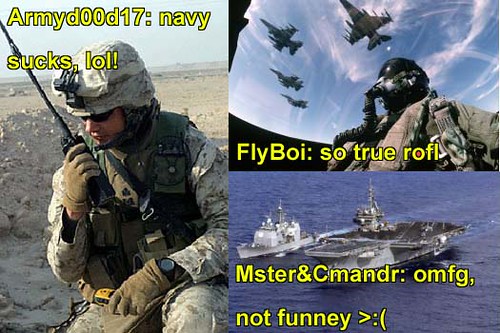
Defense LOLs - 31 July 2007

This quote is from a Boston Globe puff piece on the Navy's $3 billion-a-pop DDG-1000 Zumwalt class destroyers:

Its challenge will be to orchestrate the medley of technologies produced by more than 700 suppliers in 40 states while avoiding the cost overruns that have plagued past Navy shipbuilding programs. "Cost realism is important," said Edward Geisler, the Raytheon vice president and program manager for the Zumwalt class destroyers.

lol. Now pull the other one. This guy must have taken notes from the Northrup Grumman when they made the B-2 -- better yet, from Boeing and Future Combat Systems.

Friday, July 20, 2007

Military doctrine under 'informatization'

Despite my earlier jab, Barry Rosenberg's cover article from this month's Armed Forces Journal is really fantastic. His thesis? The U.S. military must be prepared to make some enormous cultural changes if it really wants to embrace network-centric warfare:

Until recently, collection assets would feed information up the line to divisional commanders and they would pass it up or parcel it down on a need-to-know basis. However, today, many war fighters have access to the same data as their commanders and are being given the opportunity to not only critique that information but also to act upon it independently of commanders' orders.

As a result of everyone having access to the Global Information Grid (GIG), leaders are faced with the challenges of commanding young men and women who have been plugged in to communications and entertainment devices since they were kids, while at the same time respecting the traditional pyramid model of command. In many instances, the growing pains are obvious.

"There's no way to run a military without a hierarchical structure," said retired Lt. Gen. William Odom, a senior fellow at the Hudson Institute and former director of the National Security Agency under President Reagan. "When you hook everyone up to the Internet and give them processing capability, you are essentially flattening the chain of command. If everybody is making independent decisions, the likelihood they will be coordinated to a mission goes down."

Odom said that what we're experiencing today are "constipated information channels" and "diarrhea of the e-mail." Both have increased the capability and propensity of senior leaders to micromanage from afar. The question now is whether the military can develop senior commanders who will allow lower commanders to make decisions — and then stay out of their hair and live with the results.

In the broadest sense, LTG Odom is right -- the military requires a certain amount of hierarchy that is irreducible. If the general knew his history though, he would know that the idea of 'hierarchy' is sometimes flexible.

I imagine a guy like Field Marshal Donald Haig back in 1915 would have rejected the idea of using fire teams to infiltrate enemy trenches. He would have argued that giving foot soldiers enough autonomy to maneuver on their own would reduce the 'likelihood they will be coordinated to a mission' as well. Two years later, Germany's stormtroopers mostly proved him wrong.

[On an interesting historical note, stormtroopers weren't actually a German idea, but were instead based on the writings of a French Army captain named Andre Laffargue. He proposed this strategy of small units and infiltration to the French General Staff in 1915 and they dismissed it out of hand. In response, Laffargue self-published the operational concept as a pamphlet, which the Germans captured and translated in 1916.]

So how should the military resolve this issue of autonomy? Rosenberg gives commanders a simple four-point plan: 1) Clearly articulate the objective, 2) provide your troops with operational boundaries, 3) set their rules of engagement, and 4) take a very hands-off approach. Frankly, I couldn't agree more. U.S. troops are smarter and better trained today than at any point in the military's history. Sure, they will probably need more classes in anthropology and foreign languages, but changing that is easy enough.

Rosenberg also converges with Marine General Charles Krulak's idea about the strategic corporal. Krulak argues that future battlefields and future missions will be so complex and fluid that troops on the ground will rarely have time to reach up the chain of command for orders. In response, the military should be prepared to devolve leadership to the lowest level, the squad leader, who is typically only a corporal.

Krulak's position seems reasonable enough, but there is a tension between his "strategic corporal" thesis and what is referred to as the "7000-mile screwdriver" -- a term coined to describe Donald Rumsfeld's micromanagement of the Iraq War. Improvements in headquarters-level situational awareness have encouraged commanders to micromanage their troops at a time when they need a greater amount of autonomy.

If current problems any indicator, giving troops more autonomy will probably be far more difficult than suiting them up for network-centric warfare. On the one hand, you have politicians who would rather blow millions on a pie-in-the-sky global strike program than take risks or ask for sacrifice. On the other, you have an inbred generation of military leaders who prefer to go into battle unprepared over providing civilian leaders with objective (but sometimes unpalatable) advice.

Matching doctrine to technology is definitely possible, let's just say I'm not confident about the prospects.

Monday, July 16, 2007

Ummm...

I will write a longer piece on Barry Rosenberg's cover article from the July issue of AFJ in the next 24 hours. First, I wanted to highlight an ironic sentence that clearly deserves the label pentagonism:

Third, the commander must set the rules of engagement. On the military side, such rules might be "don't fire unless fired upon" or "don't bust down doors in a culture that finds that tactic extremely insulting."

I don't know about you all, but I imagine most people, regardless of culture, would probably feel insulted by having their door busted down -- especially by a bunch of well-armed foreign soldiers. Somehow, I don't think the 12,000 M100 Grenade Rifle Entry Munitions that the Army is going to buy from Rafael will be popular either.

Thursday, July 12, 2007

So why Azerbaijian and does it matter?

I imagine that by now, most of my readers have had a chance to read Noah Shachtman's piece on FCS and Azerbaijan. For those who have not, I will summarize: As part of the Operational Requirements Document used to justify the efficacy of Future Combat Systems, the Army prepared a summary mission profile for a hypothetical set of missions. These hypothetical missions just happen to take place in the oil-rich former Soviet state and now Republic of Azerbaijan.

At this point, some of my readers are probably asking themselves: "Azerbaijan, is that like where Borat goes for summer vacation or something? Why did the Army pick that place?" To be certain, Azerbaijan wasn't selected for political reasons. Azerbaijan isn't exactly the most democratic ex-Soviet state, but the government of President Ilham Aliyev is pretty friendly with the United States. Plus, the U.S oil firm Unocal (now part of Chevron) also owns about a 9% stake in the $3.6 billion Baku-Tbilisi-Ceyhan oil pipeline.

Azerbaijan may be a friend, but is one of the roughest and most volatile neighborhoods in the world. The Azeris and the Armenians fight over Nagorno-Karabakh, the Georgians and the Russians fight over Abkhazia and South Ossetia, and the Armenians and the Turks fight over whether the Ottoman Empire committed genocide against ethnic Armenians in 1915-1917 (I am definitely not going to wade into that one). To top that off, all of this strife crammed into a small mountainous region sandwiched between Iran and Chechnya. Sometimes I'm surprised that countries stopped bickering long enough to allow the 1776 kilometer Baku-Tiblisi-Ceyhan pipeline get off the drawing board.

Small, U.S.-friendly, oil-producing state locked in a far-off, volatile region of the world. Doesn't that sound like another country in the Near East, one that we've successfully liberated before? Kuwait perhaps?

In my view, Azerbaijan was picked because its size, terrain, and political environment fit the assumptions that shape FCS. They picked a relatively small country to accentuate the ability of a single FCS Brigade Combat Team to rapidly achieve "decisive maneuver" against a larger opposing force in 48-60 hours. Azerbaijan is also a relatively remote, mountainous area bordered by few U.S. allies. This reflects the Army's emphasis on performing combat operations on short notice and without pre-positioned equipment. Finally, there is the potential (however remote) that the Army may be called upon to one day liberate the Azeris from an encroaching neighbor. Remind anyone of an incredibly successful "left-hook" the Army pulled off a little more than 15 years ago?

My main concern with the Azerbaijan scenarios is that they highlight a fundamental flaw of FCS. This billion-dollar force recapitalization project is focused on refining existing capabilities at a time when the Army needs to develop entirely new capabilities. To me, being able to successfully conduct stability operations campaign the day after a 72 hour blitzkrieg is worth far more than shaving that blitzkrieg down to 48 hours. Does the Army honestly expect a brigade of 4000 troops trained and equipped for maneuver warfare against a modern opposing army to manage 8 million people spread over a country the size of Maine? We have multiple brigades in Baghdad (a city of 7 million) and they can't even keep the peace without support from the Iraqi military.

At the very least, one would hope that as soon as images of the National Carpet Museum in Baku being looted by anonymous brigands are splashed across CNN the hypothetical Secretary of Defense overseeing one of these imagined combat operations would have something more conciliatory to say than 'Stuff happens.'

I'm not saying the Army doesn't need to recapitalize the force and I'm not exactly opposed to the idea of network-centric warfare either. I'm just arguing that the Army's vision of the future force is shackled by a set of overly narrow assumptions about what kind of wars it will fight. As Colin Gray asked in a great monograph published by the Army War College back in 2005, if the Army is putting all of its development dollars into FCS, is FCS robust enough to counter the broadest set of future war scenarios? In terms of fighting a major urban counterinsurgency campaign (Iraq) or managing a fractured, poor state (Afghanistan), I think the evidence is pointing towards 'no.'

Monday, July 2, 2007

My 8 hour irony-fest

So I was stuck representing the Army at a Department of Defense-wide meeting hosted by the Office of the Secretary of Defense all day today. We were talking about a currently contentious piece of security cooperation policy. As one might expect, the meeting quickly degenerated into a bland war of words over bureaucratic turf, but I did notice one thing: Even in a community that is as abstracted from the soldiers in the field as security cooperation policy, the cultural stereotypes about different DoD components still hold true.

The security cooperation community recently experienced in a significant slowdown in one its main policy processes. In response, each military department proposed a solution that largely matched up with the strategic preferences described in Carl Builder's classic The Masks of War:

1. The Navy thought the problem could be fixed by giving the military departments more autonomy and delegated authority.

2. The Air Force wanted to introduce a cutting-edge information technology application to improve communication and situational awareness.

3. The Army argued that each service should dedicate more manpower to tackling the issue.

In addition to the predictable responses of each military department, the proposals of the other DoD components present were fairly stereotypical. The Missile Defense Agency thought increasing visibility with the executive branch was the answer, while the Defense Threat Reduction Agency believed we should take the issue to Congress. Not surprisingly, the Defense Advanced Research Projects Agency wanted to throw out current procedures and rules in favor of a high-risk, experimental approach.

The entire meeting was so ironic that if you had thrown in a Mountie, a Sumo wrestler, a mariachi band and a French guy in a beret smoking cigarettes, one might easily mistake it for an elaborate costume party -- or as I saw it, a cruel joke.